
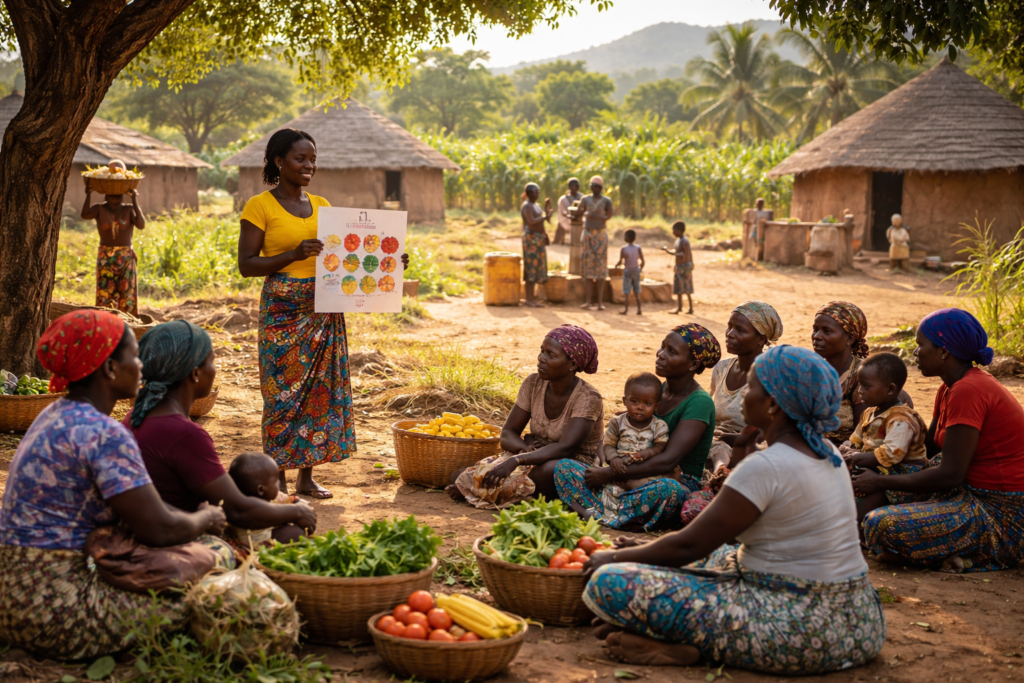
For the longest time, the global health community has rightly recognized the importance of maternal care as a foundational pillar of healthy societies. But what if this essential focus is just the first chapter in a much bigger story? The next frontier in global development lies in expanding our view and our investments in mothers beyond traditional health programs and into a foundational economic strategy. The path to national prosperity is built by a systems approach that deliberately connects health, nutrition, and education, creating a powerful chain that not only uplifts families but strengthens communities and enables long-term, sustainable growth. Consider a community-based nutrition intervention that trains mothers to fortify children’s food with locally sourced ingredients.
Yet the deeper, systemic victory was economic: a healthy child means a mother was free. Freed from the constant care of a chronically ill child, she can reclaim her time and channel her energy into productive work, education, or nurturing her other children. This is the critical first link in the chain: from child health to maternal agency, and from agency to economic participation.
However, this chain is only as strong as its weakest link. A mother equipped with nutritional knowledge cannot safeguard her family if the broader food system is unsafe. ACE’s in-depth analysis of Nigeria’s food safety landscape, conducted for the Nigerian Economic Summit Group, reveals a fragmented system with over a dozen agencies operating in silos. This lack of coordination is not just a policy inefficiency; it is an economic and health crisis, contributing to an estimated 200,000 deaths from foodborne illness annually.
In such a context, even the most informed women are constrained by systemic failures demonstrating how poor coordination at the national level can actively undermine women’s efforts at the household level. Effective community nutrition, therefore, depends on effective national policy alignment; the micro and macro systems must work together.
This reality demands a paradigm shift: from funding isolated projects to architecting coherent ecosystems. This is where strategic thought partnership becomes critical. The work of ACE Strategy and Consult exemplifies this systems-level approach. Beyond supporting frontline innovations, ACE provides the strategic scaffolding that allows them to scale. For example, in partnership with the Gates Foundation’s Family Health Division, ACE developed integrated national strategies, partner coordination maps, and high-level advocacy frameworks. This “meso-layer” work, ensuring data coherence, aligning stakeholder priorities, and streamlining workflows, is what transforms a successful pilot in one state into a sustainable model for a nation.
The imperative for policymakers and donors is clear. Sustainable impact and genuine economic return require investing in this integrated model. The return is measured not only in health statistics but in a more productive workforce, a more resilient agricultural and food economy, and more fiscally sustainable communities. It is measured in the powerful chain reaction that begins with a single healthy woman and extends to the prosperity of her nation.
Forging this future requires partners who think in systems and act as integrators. It demands the strategic fusion of grassroots insight, policy analysis, and multi-stakeholder coordination. ACE Strategy and Consult operates at this nexus, leveraging evidence from community projects and national policy briefs to design and advocate for the resilient systems that make women’s health a true engine of economic prosperity. The blueprint is here. The opportunity is now. The task is to connect the links.