
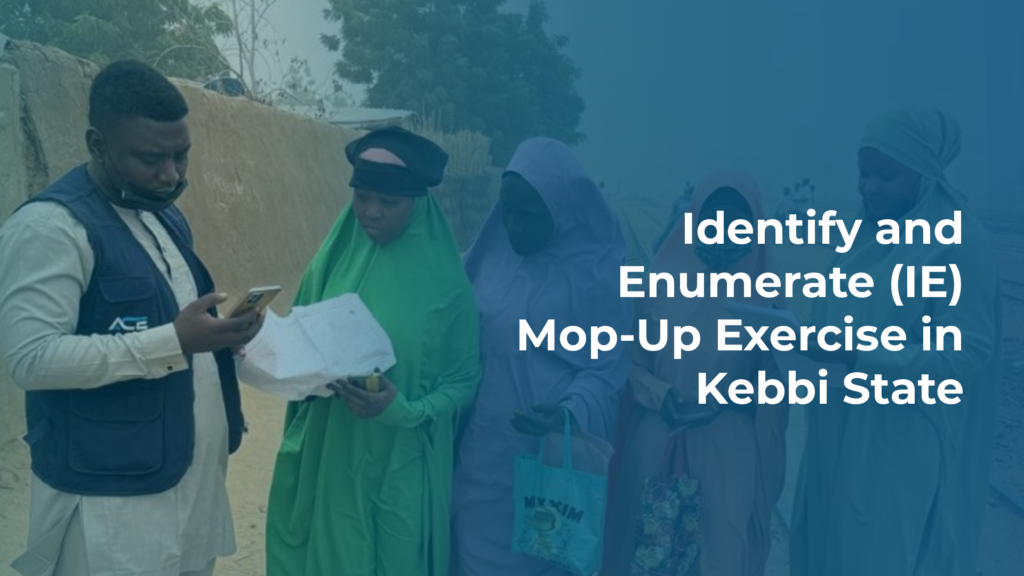
Identify and Enumerate (IE) Mop-Up Exercise in Kebbi State
Background
Nigeria continues to face persistent challenges in obtaining accurate data on children under five, a critical input for population planning, routine health service delivery, and targeted interventions. Reliance on population estimates and modelled projections has often led to inconsistent program outcomes. In line with its 2023–2026 Strategic Blueprint, the National Primary Health Care Development Agency (NPHCDA) conducted an Identify and Enumerate (IE) exercise in six northern states to improve accuracy in counting under-five children and pregnant women. To complement this effort, the Nigerian Institute of Medical Research (NIMR) funded a mop-up exercise aimed at validating and expanding the initial enumeration by identifying missed settlements and refining population estimates. ACE Strategy & Consults was engaged to implement the mop-up in 11 LGAs of Kebbi State, ensuring complete and accurate enumeration of target populations.
Our Approach
The exercise was delivered in three phases: New Settlement Baseline Identification, Field Deployment & Data Collection, and Data Review, Validation & Reporting. ACE coordinated the recruitment and deployment of trained enumerators and supervisors to conduct ground-level enumeration using an updated settlement baseline. Activities included targeted refresher training, structured daily deployment, real-time monitoring, and feedback mechanisms. Field teams were tasked with identifying unreached settlements, enumerating all target population groups, and marking households. Data was collected using the CommCare application and subjected to daily validation to ensure accuracy and completeness.
Results
The mop-up successfully enumerated 143,614 under-five children, 26,747 girls aged 9–14 years, 128,529 women aged 15–55 years, and 57,873 pregnant women across all 11 LGAs. Coverage also included 379 newborns (0–28 days) and 3,390 infants aged 1–9 months. Despite full LGA coverage, operational challenges were recorded, including poor road access to hard-to-reach settlements, flooding, network limitations, and delays in engaging field personnel due to attrition and compensation issues. Additional issues included misassignment of settlements to incorrect team codes, slow app performance, and community resistance where enumerators were not from the local area.
Recommendations
Future enumeration efforts should recruit enumerators from target communities to improve local acceptance and reduce resistance. Training timelines should be extended to ensure readiness, and terrain pre-assessments should be conducted to design flexible deployment strategies for difficult areas. Data system improvements should include real-time validation protocols, accurate team-code mapping, and stronger collaboration with digital tool providers to resolve technical glitches promptly. These measures will improve accuracy, operational efficiency, and community trust in future large-scale enumeration exercises.
Partners
(NPCHDA)|Nigeria Institute of Medical Research (NIMR)