
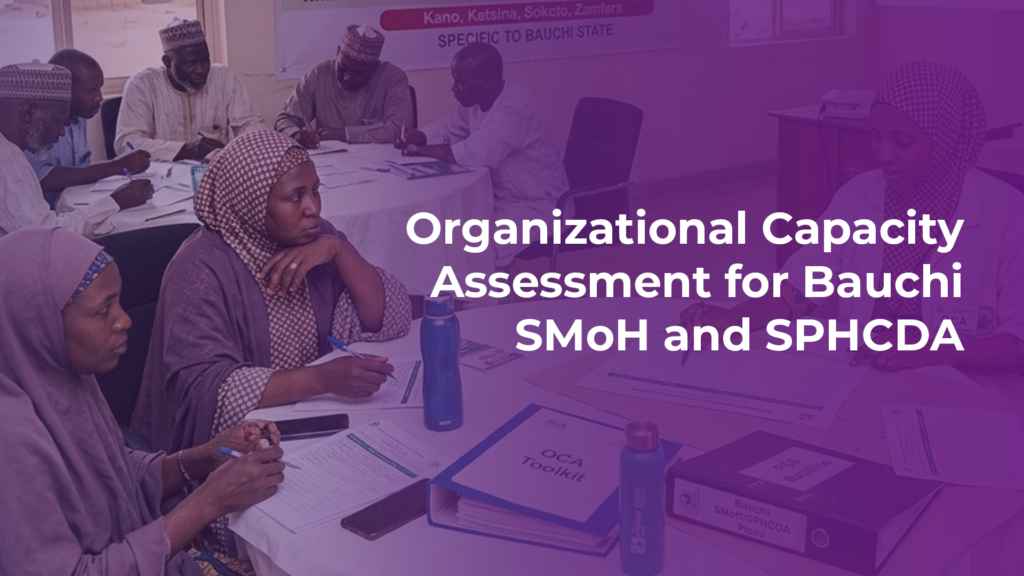
Organizational Capacity Assessment for Bauchi SMoH and SPHCDA
Context
To determine the readiness of Bauchi SMoH (State Ministry of Health) and SPHCDA (State Primary Health Care Development Agency) to effectively drive key Psychosocial Support (PSS) activities, an organizational capacity assessment of key Bauchi SMoH and SPHCDA stakeholders was carried out. The assessment was carried out to understand and establish the baseline capacity within the organizations across key health system strengthening activities.
Approach
The Organizational Capacity Assessment (OCA) was conducted with five experienced SMoH staff and five key Bauchi SPHCDA staff across key domains. For the SMoH, the domains were Governance, Health Financing, Health Management Information Systems (HMIS), Human Resources for Health (HRH), and Service Delivery. SPHCDA had the first four domains in common with SMoH with the fifth and sixth domains being Demand and Supply for FP and Supply Chain. The methodology included a comprehensive review of several literature and OCA tools, the development of a contextualized OCA tool, and validation with key stakeholders. The tools were pretested to ensure reliability and validity. The team conducted self-scoring sessions, facilitated participatory discussions, and the data was analyzed to identify strengths and weaknesses. Each domain was rated on a scale from 0 (no capacity) to 4 (expert capacity), providing a clear baseline for capacity-building efforts.
Results
The Bauchi SMoH demonstrated advanced capacity in governance (3.3/4), with robust coordination and strategic planning. Advanced capacity was also demonstrated in HRH recruitment showing clear recruitment guidelines and regular staff appraisals, though HRH needs assessments and upskilling programs were lacking. The results however highlighted weaknesses especially in the Health Financing Domain (0.3/4) showing critical gaps in budget allocation, financial tracking, and advocacy capabilities.
The OCA revealed that Bauchi SPHCDA performed well in Governance and Health Financing, demonstrating robust financial management systems and clear strategic plans. However, the agency scored moderately in HMIS (2.6) and Demand and Supply for FP (2.6), with gaps in FP provision guidelines and demand generation tracking. The Supply Chain domain scored the lowest at 2.3, indicating a critical need for improvements in commodity procurement. These findings highlighted the importance of targeted interventions to address capacity gaps and ensure the effective delivery of FP and reproductive health services.
Partners: ACE Strategy and Consults | Bauchi State Ministry of Health | Bauchi State Primary Health Care Development Agency | Options Consultancy Services