
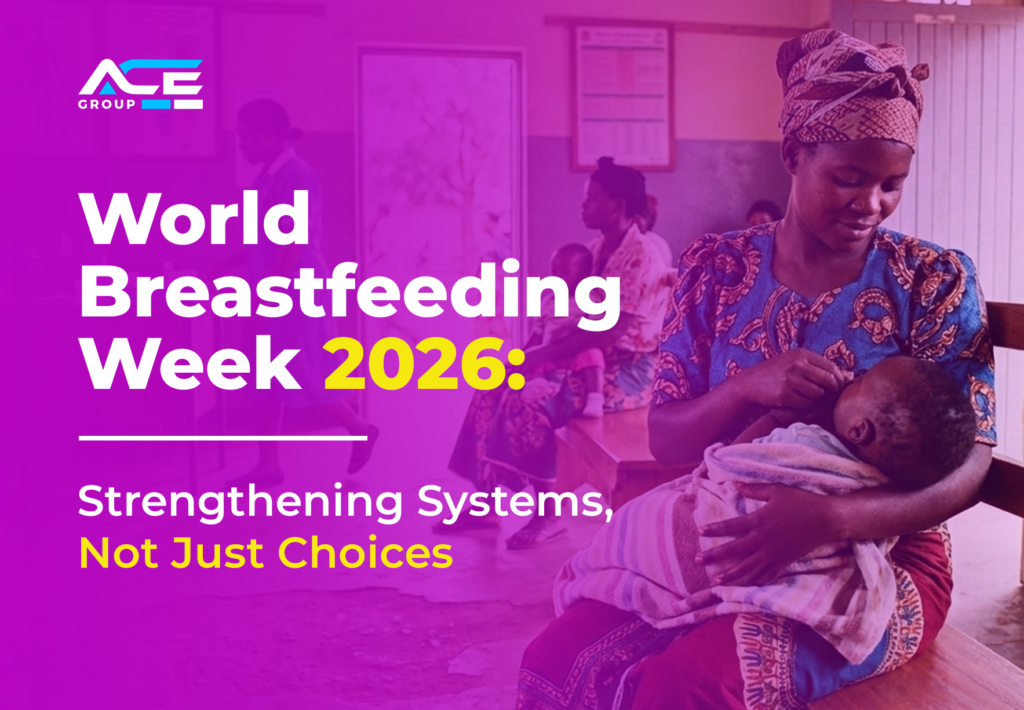
World Breastfeeding Week 2026: Strengthening Systems, Not Just Choices
Each year during World Breastfeeding Week, we celebrate the unmatched benefits of breastfeeding for children, mothers, families and societies. This year’s theme, “Breastfeeding for a Sustainable Start in Life: Strengthen What Works,” challenges us to move beyond awareness and focus on the systems that enable breastfeeding. The campaign calls on governments, health systems, workplaces, communities, civil society organisations and families to identify proven interventions and scale them effectively.[1]
As a paediatrician, I have spent years caring for newborns and young children. Today, through my lens on health systems strengthening as a technical advisor on Maternal, Newborn, and Child Health (MNCH), I have come to appreciate an important reality; the success of breastfeeding is rarely determined by a mother’s desire alone. It is largely determined by the strength of the systems around her.
The Fallacy of Individual Responsibility
Often, conversations about breastfeeding focus exclusively on mothers. We speak about knowledge gaps, commitment, or cultural beliefs. Although these factors matter, they tell only part of the story.
Across Nigeria, many mothers want to breastfeed, yet they encounter barriers at every stage of care. Some deliver in facilities where immediate skin-to-skin contact is not routinely practiced, while others are separated from their babies after birth. Many return to work without lactation support, while some receive conflicting advice from healthcare workers, family members, and online sources.
When breastfeeding fails, it is tempting to view it as an individual failure. In reality, it is often a systems failure. World Breastfeeding Week 2026 is therefore timely in reminding us that many effective interventions are already known. The challenge is to ensure they are implemented consistently and at scale.[1]
Nigeria’s breastfeeding challenge.
Nigeria has made some progress in exclusive breastfeeding over the years, but the pace is not fast enough. The Nigeria Demographic and Health Survey 2023–24 shows that only about 36% of newborns are put to the breast within one hour of birth, and only about 29% of infants under six months are exclusively breastfed, which remains below WHO’s global target of 70% for early initiation of breastfeeding and 60% for exclusive breastfeeding, respectively. In addition, only approximately 28% of children continue breastfeeding until the age of two. This means that many Nigerian newborns and young children miss critical opportunities that can influence survival, maternal bonding and, ultimately, quality of life.[2]
The pertinent question is not whether mothers value breastfeeding; it is whether our systems consistently enable it.
Strengthening What Works in Health Facilities
One of the most effective settings for improving breastfeeding outcomes is the health facility. WHO and UNICEF continue to emphasise the importance of the Baby-Friendly Hospital Initiative and the Ten Steps to Successful Breastfeeding. In ppracticalactical terms, this means:[3]
Immediate skin-to-skin contact after birth.
Initiation of breastfeeding within the first hour
Rooming-in practices that keep mothers and babies together.
Consistent infant feeding counselling by trained healthcare workers.
Elimination of unnecessary prelacteal feeds.
These are not expensive interventions. They are systematic interventions that require leadership, training, monitoring, accountability and community ownership.
As health care professionals, we must therefore examine our own practices and ask whether our facilities truly support breastfeeding from the very first moment of life.
Investing in Health Workforce
Breastfeeding support does not begin and end in the labour ward. Mothers need skilled counselling during antenatal care, immediately after delivery, during postnatal visits and throughout infancy. Skilled Infant and Young Child Feeding counselling can substantially increase exclusive breastfeeding rates when delivered through health facilities, households and communities.[1] This requires sustained investment in training of frontline and community health workers, structured lactation support services and standardised breastfeeding counselling messages.
The most sophisticated national breastfeeding policy will achieve little if frontline workers lack the skills, confidence or time to support mothers effectively.
Supporting Mothers Beyond the Health Sector
Health systems alone cannot solve breastfeeding challenges. Workplaces play an equally important role, as WHO has identified paid maternity leave, breastfeeding breaks and dedicated nursing spaces as important family-friendly policies that support breastfeeding outcomes.[4]
For many Nigerian women, especially those in the formal workforce, returning to work often marks the start of breastfeeding difficulties.
Employers can become powerful allies by providing adequate maternity leave, flexible working arrangements, lactation rooms, breastmilk storage facilities and breastfeeding-friendly workplace policies. When workplaces support breastfeeding, mothers do not have to choose between earning a living and providing optimal nutrition for their child.
The Role of Data and Accountability
One of the strongest messages of this year’s World Breastfeeding Week is the importance of measuring progress and scaling successful approaches.[1] What gets measured gets improved.
Countries and institutions should routinely track early initiation of breastfeeding, exclusive breastfeeding rates, baby-friendly hospital compliance, and the availability of breastfeeding support services, among others.
Data should move beyond reporting and drive action. If a facility’s early initiation rate is low, leadership should find out why. If a state or community is consistently underperforming, targeted interventions should follow. Ultimately, strengthening systems means creating feedback loops that turn evidence into improvement.
A Call to Action
Breastfeeding is one of the most powerful and cost-effective interventions for optimal child survival and development. Yet breastfeeding does not happen in a vacuum. Mothers succeed when systems support them.
As we mark World Breastfeeding Week 2026, let us shift the conversation from individual behaviour to collective responsibility. Let us strengthen what works: Baby-Friendly facilities, skilled counselling, maternity protection, community support, workplace accommodations and robust monitoring systems.[1]
As a paediatrician and MNCH advisor, I remain convinced that improving breastfeeding outcomes in Nigeria will require more than advocacy. It will require intentional investment in the systems that surround every mother and every child, because when systems work, breastfeeding works.
And when breastfeeding works, children thrive.
References
- World Health Organization. World Breastfeeding Week 2026: Breastfeeding for a sustainable start in life: strengthen what works. Geneva: World Health Organization; 2026.
- Federal Ministry of Health and Social Welfare, National Population Commission, ICF. Nigeria Demographic and Health Survey 2023–24: Key Indicators Report. Abuja, Nigeria, and Rockville (MD): National Population Commission and ICF; 2024.
- World Health Organization, UNICEF. Implementation guidance: protecting, promoting and supporting breastfeeding in facilities providing maternity and newborn services—the revised Baby-Friendly Hospital Initiative. Geneva: World Health Organization; 2018.
- World Health Organization. Breastfeeding and family-friendly policies: an evidence brief. Geneva: World Health Organization; 2019.
About the Author
Dr. Aisha Suleiman FWACP(Paed) is a Consultant Paediatrician, Fellow of the West African College of Physicians (Paediatrics), and public health professional with over a decade of clinical experience in paediatrics. Passionate about improving maternal, newborn, and child health outcomes, she combines frontline clinical expertise with research, advocacy, and health systems strengthening to advance evidence-informed policies and programmes. Through her work, she is committed to translating knowledge into action that improves the quality, accessibility, and equity of healthcare for children and families.